
Walter’s connections: How he moved our subject on after plate tectonics, by Tony Watts
Walter’s fundamental contributions to seafloor spreading and plate tectonics are legendary. Like many scientists under the direction of ‘Doc’ Ewing at Lamont in the 60s Walter followed the classic scientific method: from observation, through data processing to interpretation. He spent much of the early 1960s at sea as a technician on Vema. By the time of Vema 1707 he was a Chief Scientist making ocean bottom and surface ship magnetic measurements. He continued to be actively sea going on Vema, Conrad, and Eltanin well into the late 60s and early 70s – a time when ,quite remarkably, Lamont was running up to 30 cruises a year. In between cruises Walter reduced the total magnetic field data acquired to anomalies. Included in this data was the ‘magic profile’ acquired by Chief Scientist Merle Dawson on Eltanin 19 in August 1965 across the crest of the Pacific-Antarctic ridge at 51.6o S. Walter showed the profile to some of the attendees of a meeting held at NASA Goddard in New York chaired by Teddy Bullard in November 1966 and published the profile a month later in Science [Pitman and Heirtzler, 1966]. The following Spring the profile was shown, along with many other profiles of other ridges, at AGU and its significance for continental drift and seafloor spreading and, eventually, plate tectonics was widely recognized.
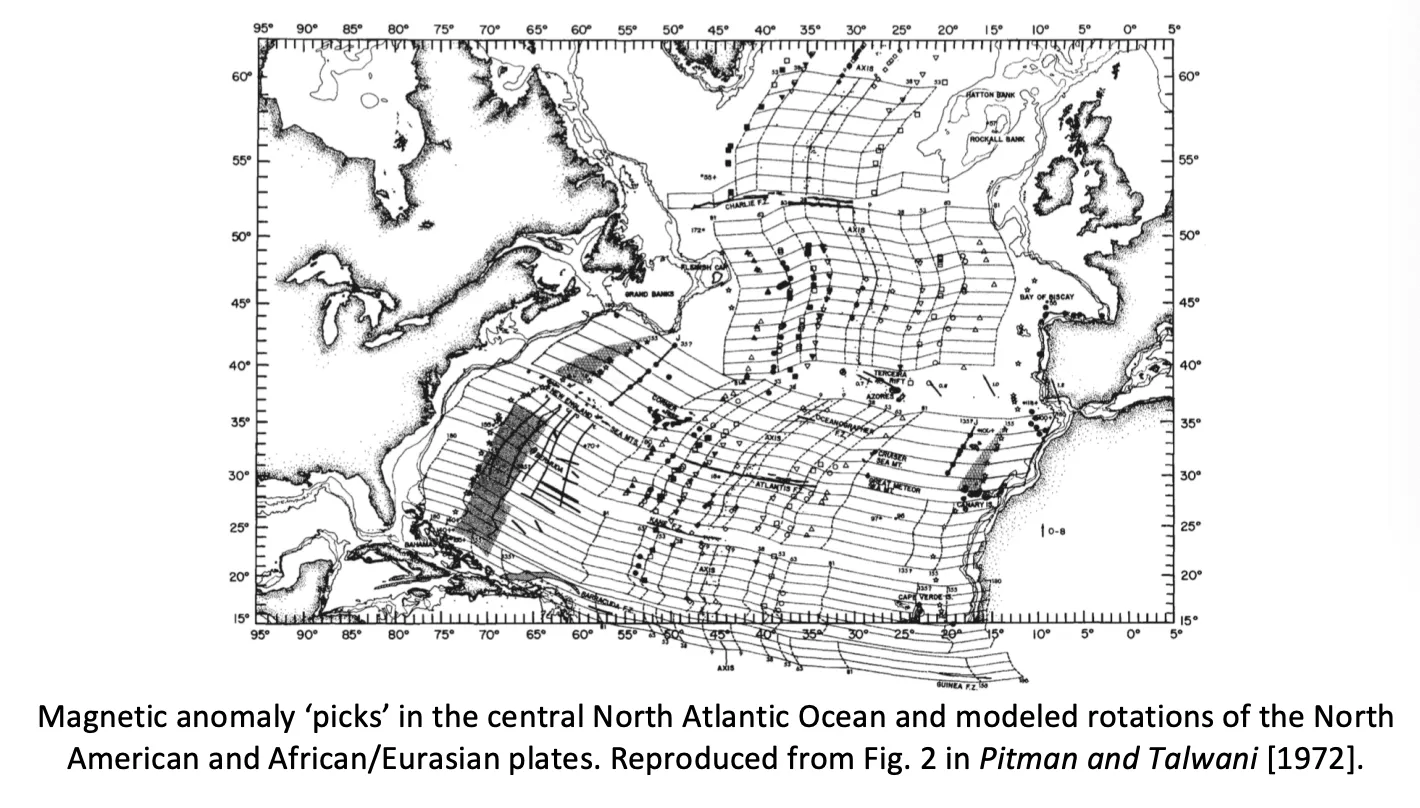
I first met Walter in the Fall of 1971. My wife and I had just driven down to Lamont from Dartmouth, Nova Scotia in an old English car. On arrival we walked into the ‘gravity module’ on the ground floor of Oceanography and there was Walter huddled over a light table with Manik Talwani putting the finishing touches to their classic paper on the separation of North America and Africa and opening of the North Atlantic Ocean. It was my first introduction to Walter who quickly became both colleague and friend.
To many of us young post-docs at Lamont in the early 70s it was not immediately obvious what we should work on following the stunning successes of plate tectonics. Should we continue with more detailed kinematic studies of the plates or should we focus more on their physical properties in order to understand why they behaved so rigidly for long periods of time? Walter must have wondered too how best to follow his seminal works in marine magnetics and on seafloor spreading and the age of the ocean basins.
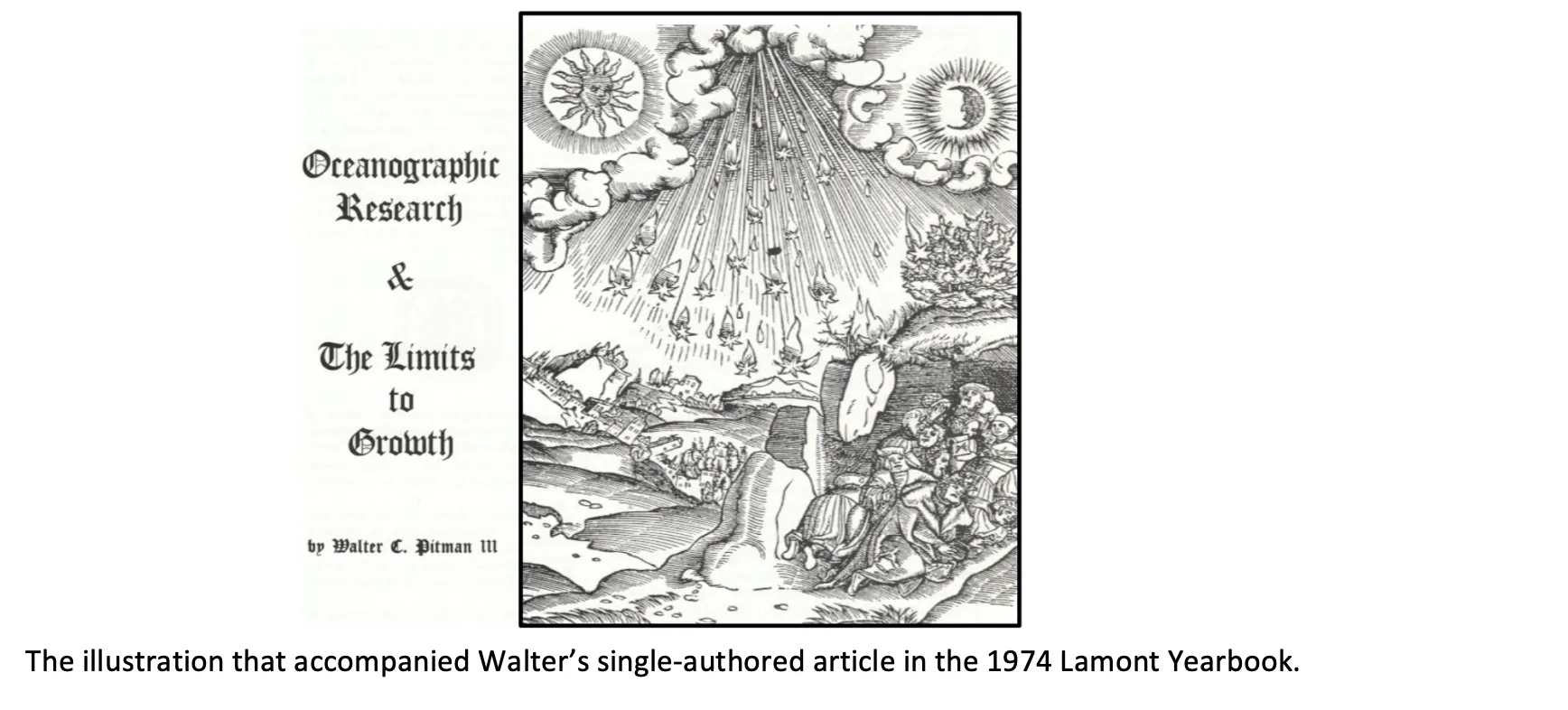
A clue as to Walter’s thoughts on the matter appeared in an unlikely place. In a 5- page article in the 1974 Lamont Yearbook [Pitman, 1974] Walter considered the fragile nature of the Earth system, querying how the planet could sustain rapid growth in its economic development and population. The oceanographic sciences had a role to play he argued, especially as it might help address issues such as the impacts of pollutants on marine life on the shallow shelves and radioactive and other waste disposal in the deep sea. And more generally he thought that geoscientists were well placed to address global societal problems such as those associated with the build up of CO2 in the atmosphere, paleoenvironmental change and mineral resources.
Walter’s own research directions were to shift. He started to explore the connections between plate tectonics and long-term sea-level change and the development of stratigraphic sequences: connections that were eventually to lead to new discoveries.
Prior to the 70s, studies of long-term sea-level change had been limited to the study of sedimentary facies and the mapped extent of marine inundation of the continents (e.g. Strakhov, 1948; Termier and Termier, 1952). Such studies were significant in that they provided information on the timings of major transgressions and regressions, but they were qualitative and only provided information on the relative rise and fall of the seas, not the magnitude or rates of sea-level change through time.
Walter’s first paper on the subject, co-authored with Jim Hays, was a milestone since it pioneered the quantification of long-term sea-level change [Hays and Pitman, 1973]. By using the spreading rate and ridge length of most of the world’s mid-ocean ridges, calculating the change in volume of different ridge segments at different time intervals, and then converting these changes to sea level change taking into account isostasy and continental hypsometry, Jim and Walter were able to show that the freeboard (the height of the sea to an observer on land) reached a peak of ~386 m in the Late Cretaceous (~85 Ma) and then fell gradually during the Tertiary to ~47 m in the Late Miocene (~10 Ma). The result had broad Earth and environmental implications that they were able to explore for climate change, faunal diversity and ocean circulation.
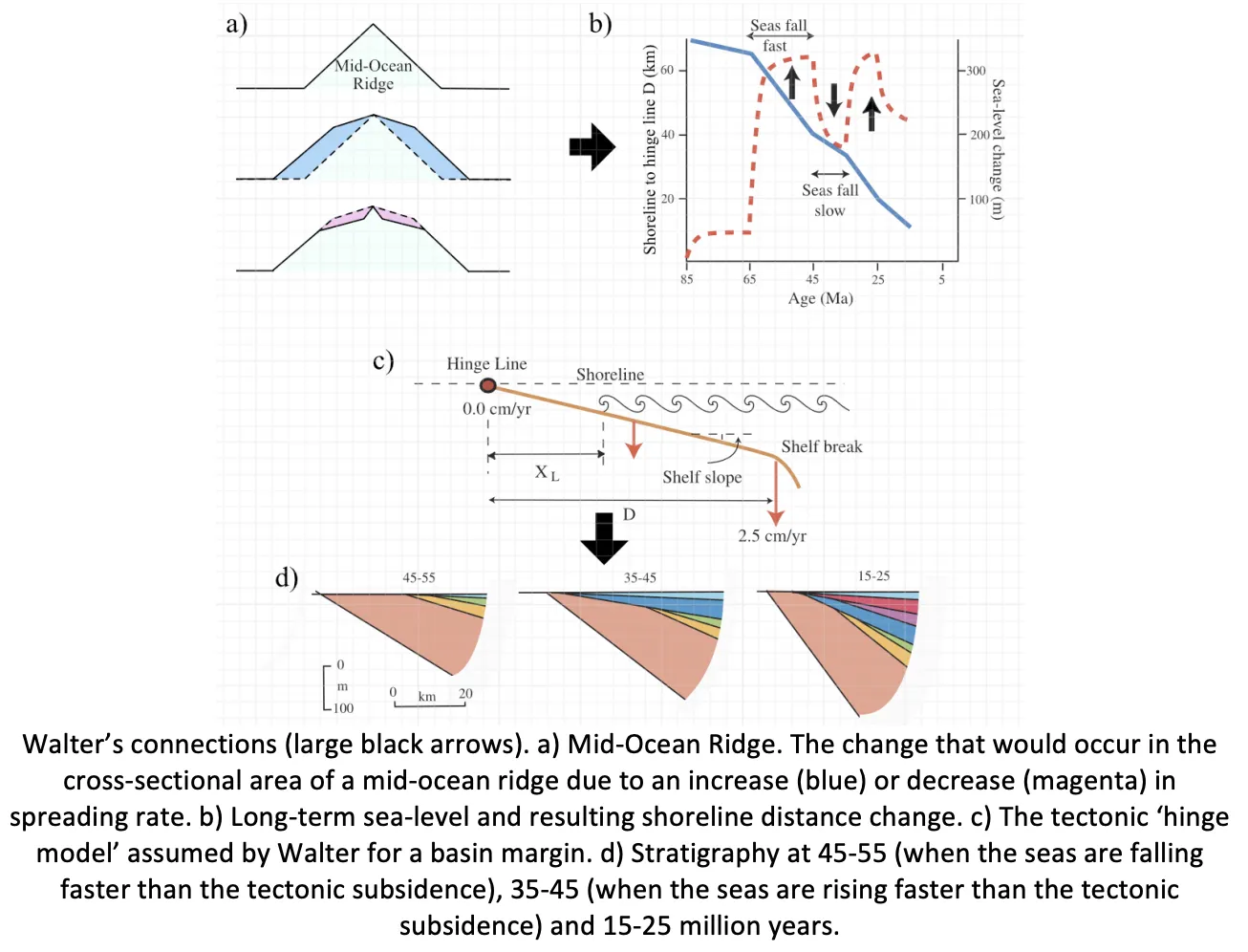
The second, and arguably Walter’s most significant, was the connection he made between sea-level change and the development of stratigraphic sequences in sedimentary basins [Pitman, 1978]. It was well known that transgressions and regressions of the seas controled sedimentary facies and stratigraphic sequences at basin margins. However, outside of Pleistocene glaciations where sea-level change is often manifest in well preserved raised beaches and submerged coastlines there were was little understanding of how changes in sea-level change might control features seen in outcrop such as coastal onlap and offlap patterns and sequence boundaries. Walter made the connections by assuming a simple hinge model and what he proudly called a ‘back of the envelope calculation’ to show that the movement of a shoreline across a basin margin depends not on the absolute change in sea-level, but on the relative rate of change of sea-level and tectonic subsidence. This result had immediate impact, especially to those outside of Lamont and in the hydrocarbons industry who were inferring sea-level change directly from seismic reflection profile data.
Within Lamont the work had impact too. In the ‘gravity group’ we had been working on plate bending at deep-sea trenches and had started to wonder with Bill Ryan how loads such as river deltas might be accommodated by the crust. Our musings led to ‘backstripping’ and a method to unload sediments and isolate the tectonic subsidence of basins. Walter’s work inspired us to use the subsidence to derive the freeboard directly from the stratigraphic record. Much later, Bill and Walter [Ryan and Pitman, 1998] were to seek the stratigraphic response to melt waters that had burst through the Bosporus and into the Black Sea and its possible link to the biblical narrative of Noah’s Flood.
Walter’s connections and his subsequent shift in research focus from plate kinematics to sea-level change and stratigraphy initially, I recall, raised some eyebrows at Lamont. The work was not ship-based and it did not really help the acquisition of new data, which had started to decline along with Office of Naval Research research funding in the late 70s. People asked “What is Walter doing?” But as Benjamin Bloom, the American Educational Psychologist, pointed out, making connections is an illustration of higher-order thinking and Walter’s ability to connect changes in ridge crest volume to sea-level and stratigraphic sequences on continental margins is, I believe, an exemplary example in the geosciences of such thinking.
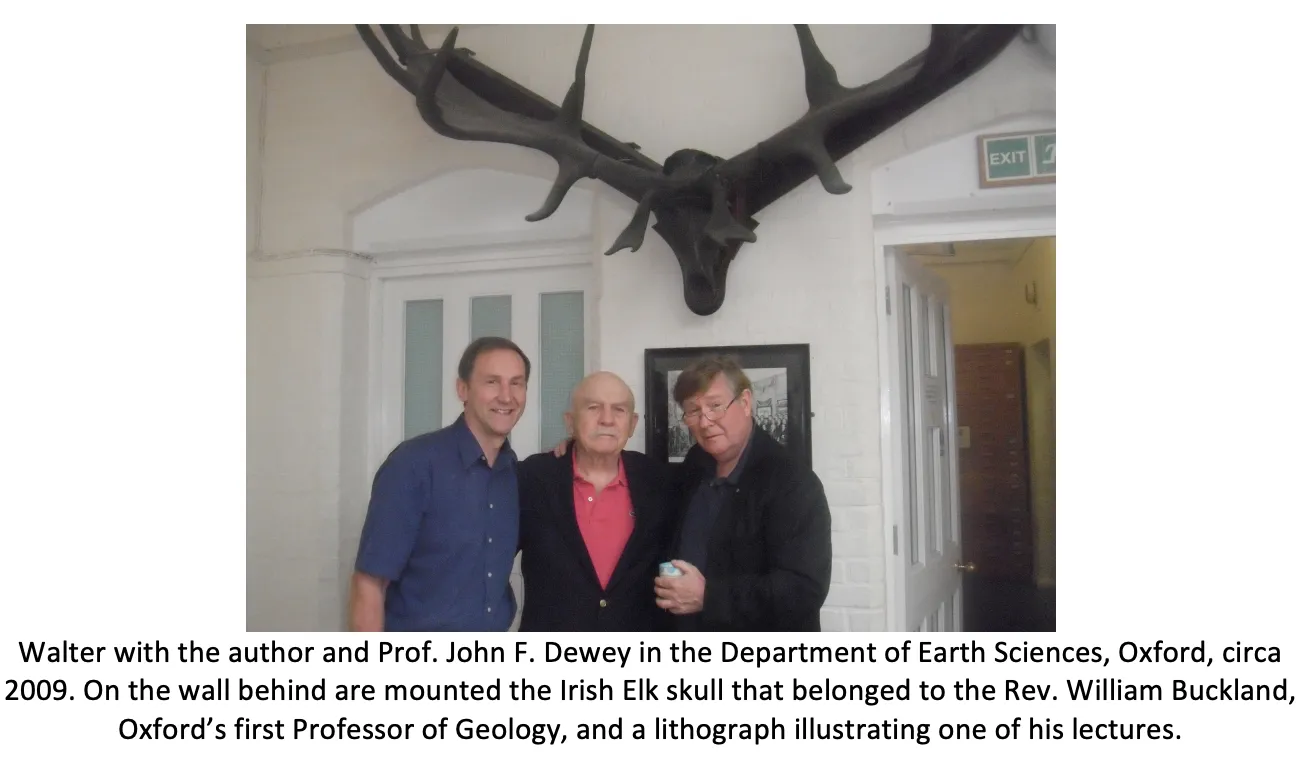
After leaving Lamont in 1990, I had the privilege to meet up with Walter on a number of occasions. We lunched together at his beloved Henry’s on Broadway and met up from time to time in Oxford. Walter was an anglophile and we enjoyed a good banter on cricket and other things. My only regret? I never did find out what a ‘gazoonie’ was or who ‘Louis per derm derm’ was. Walter was an exceptionally creative scientist: a man of culture, a humble and a gentle man, and we thank him for that.
References cited:
Hays, J. D., and W. C. Pitman III (1973), Lithospheric plate motion, sea level changes and climatic and ecologic consequences, Nature, 246, 18-21.
Pitman, W. C. (1974), Oceanographic research & the limits to growth, The Lamont Yearbook, 23-27.
Pitman, W. C. (1978), The relationship between Eustasy and Stratigraphic Sequences of Passive Margins, Geol. Soc. Amer. Bull., 89, 1389-1403.
Pitman, W. C., and J. R. Heirtzler (1966), Magnetic anomalies over the Pacific-Antarctic Ridge, Science, 154, 1164-1166.
Pitman, W. C., and M. Talwani (1972), Seafloor spreading in the North Atlantic, Geol. Soc. Amer. Bull., 83.
Ryan, W., and W. Pitman (1998), Noah's Flood, Simon & Schuster, New York, pp. 319.
Strakhov, N. M. G., 1948. (1948), Osnovy istoricheskoy geologii (Principles of Historical Geology), Parts 1 and 2., Gosgeolizdat, Moscow-Leningrad.
Termier, H., and G. Termier (1952), Histoire Géologique de la Biosphère, Masson, Paris